 +55-11-3280-2197
 +1-305-851-7982
 +44-020-8144-4939


Rio de Janeiro
Av. Presidente Wilson, 231 / Salão 902 Parte - Centro
CEP 20030-021 - Rio de Janeiro - RJ
+55 21 3942-1026

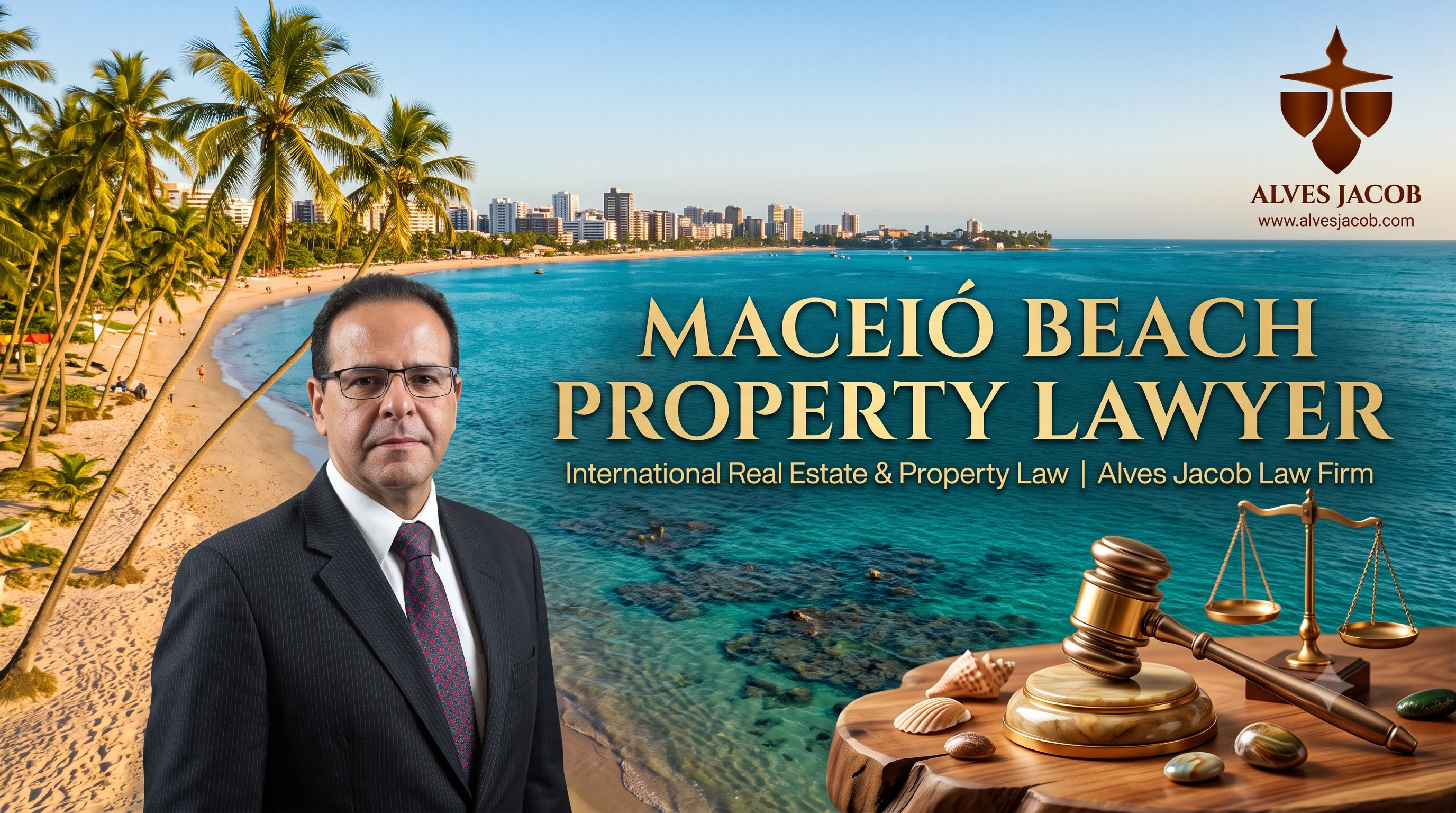
The shoreline of Maceió is among the most coveted stretches of the Brazilian northeast, drawing investors who recognize that a beachfront asset on warm Atlantic waters is a rare and durable form of wealth. Yet the legal architecture that governs coastal ownership in Brazil is far more intricate than the postcard suggests. Behind every apartment overlooking the reefs and every villa near the calm green sea lies a layered framework of federal coastal interests, municipal zoning, environmental controls, and title obligations that can either protect your investment or quietly compromise it. A dedicated Maceió beach property lawyer exists precisely to make certain that what you believe you are buying is what you actually own.
Maceió combines tropical climate, a developed urban orla, and a price profile that remains attractive when measured against comparable coastlines in Europe or North America. For the international buyer, the appeal is twofold: lifestyle and appreciation. The neighborhoods that line the sea, from the lively Pajuçara to the sophisticated Ponta Verde and Jatiúca, offer a blend of established condominium living and steady tourist demand that supports both personal enjoyment and rental income.
Strategic value, however, is only realized when the acquisition is legally clean. A beachfront property carries a unique set of public and private interests that ordinary inland transactions never trigger. The investor who treats a coastal purchase as a routine apartment deal frequently discovers, far too late, that the asset sits partly on land controlled by the federal government, or that an environmental setback restricts the very use that justified the purchase. The role of experienced counsel is to convert enthusiasm into a secure and defensible position. For the broader national perspective on coastal acquisitions, our Brazil real estate lawyer overview anchors every regional matter we handle.
Foreign investors approach Brazilian property with the legal instincts of their home jurisdictions, and those instincts, however sound elsewhere, rarely translate cleanly into the Brazilian coastal context. The notion that a clear sale contract and a handshake complete a transaction is a costly assumption. In Brazil, ownership is perfected not by the contract but by registration, and a coastal asset adds federal and environmental dimensions that demand verification before any funds move.
Specialized counsel bridges that gap. We translate the Brazilian framework into terms an international client can act upon with confidence, coordinate the documentation that foreign buyers must produce, and stand between the investor and the procedural traps that have ruined otherwise promising acquisitions. The objective is not merely to close a deal but to deliver an asset that withstands scrutiny on the day of the deed and remains unassailable for years afterward.
The first principle every coastal buyer must absorb is that the beach itself cannot be privately owned. Under Brazilian law, the sand strip and the maritime margin are public goods of common use, held in trust for the people and protected against private appropriation. No deed, however persuasive its language, can convey the beach. What a buyer acquires is the constructed property set back from that public margin, together with the legally recognized rights attached to it.
This distinction matters enormously when a seller markets a property as having private beach access or exclusive shoreline. Such promises are frequently unenforceable and occasionally fraudulent. A competent coastal attorney examines the precise boundary between the public margin and the private parcel, confirms that no construction unlawfully encroaches on protected land, and ensures that the rights conveyed are real, registrable, and free from the risk of future administrative challenge.
Much of the Maceió waterfront sits within the regime of marine lands (terrenos de marinha), a category of property in which the federal government retains underlying dominion over a defined band measured from the historic high-tide reference line. Owners of structures on these lands do not hold full freehold in the conventional sense; they hold occupation rights (ocupação) or a long-term leasehold known as aforamento, and they remain subject to obligations toward the federal heritage authority that administers public patrimony.
These obligations are concrete. A transfer of a property situated on marine lands typically requires an authorizing certificate from the heritage authority and the payment of a transfer levy known as laudêmio, alongside recurring charges such as the foro or the occupation fee. An investor who closes without confirming the marine lands status, settling outstanding charges, and obtaining the required authorization may find the registry refusing the transfer or, worse, inherit liabilities silently attached to the asset. Mastering this regime is one of the defining competences of a genuine beach property lawyer in Alagoas, and it is a frequent subject within our due diligence and closing practice.
Title verification is the heart of any responsible acquisition, and on the coast it is indispensable. The Brazilian registry operates on a parcel-by-parcel basis, with each property carrying a registration record (matrícula) that chronicles its history of transfers, mortgages, liens, and encumbrances. A property is only as secure as the chain of title behind it, and a defect buried decades in the past can surface to defeat an otherwise perfect transaction.
Our coastal title review examines the full chain of ownership, confirms that every prior transfer was lawfully executed and registered, and identifies judicial liens, tax annotations, inheritance disputes, and condominium arrears that can travel with the asset. We separate curable defects from structural ones and present the seller with a disciplined list of conditions to be satisfied before closing. This discipline is what allows an international buyer to commit capital with the assurance that the asset is clean at the moment of the deed. The deeper anatomy of this safeguard is set out in our dedicated due diligence in Brazil guidance.
International clients are often surprised, and reassured, to learn that Brazil broadly welcomes foreign ownership of urban real estate. A foreign national may acquire a beachfront apartment or an urban coastal residence in Maceió without residency, provided certain formalities are observed. The indispensable first step is obtaining a Brazilian taxpayer registration (CPF), which every buyer must hold regardless of nationality or domicile.
Beyond the taxpayer number, the foreign buyer must address documentation, representation, and currency considerations. Powers of attorney executed abroad require proper legalization and sworn translation to be effective before a Brazilian notary and registry. Funds entering the country should pass through authorized banking channels with appropriate foreign-capital registration, which preserves the right to repatriate proceeds and demonstrates the lawful origin of the investment. These are not obstacles but a sequence, and a coastal attorney sets that sequence in motion early so the closing is never delayed by a missing document. The same pathway, viewed from a complementary urban market, is detailed in our analysis of how to buy property in Copacabana.
Coastal value is shaped not only by the sea view but by the public rules that govern what may be built and how a property may be used. Maceió lies within a sensitive coastal environment, and federal and state interests in shoreline preservation interact with the municipal master plan that dictates building heights, setbacks, and permissible uses along the orla. A beachfront parcel may be subject to construction limits, vegetation protection, or usage restrictions that materially affect its value and the investor's intended plans.
An informed buyer treats these controls as part of the asset's legal identity rather than as an afterthought. We confirm the zoning classification, verify that existing construction is properly licensed, and identify any environmental constraint that could limit expansion, renovation, or commercial exploitation. For an investor whose plan depends on a particular use, this verification is the difference between a sound acquisition and a frustrated one.
Maceió presents a risk profile that distinguishes it from nearly every other Brazilian coastal market: portions of the capital have suffered severe ground subsidence that has rendered certain districts unstable and, in practical terms, uninhabitable. Properties in affected zones have lost much of their value and carry profound title and safety complications. A buyer guided only by an attractive price, or by a seller eager to exit, can walk directly into one of the most damaging real estate exposures in the country.
This is where local knowledge becomes decisive. A coastal lawyer who understands the geography of risk steers clients away from compromised areas, scrutinizes the precise location of any candidate property, and insists on technical confirmation where the slightest doubt exists. The reefs and the calm sea draw the eye, but disciplined counsel keeps the investor focused on the ground beneath the asset as much as the water in front of it.
How a coastal property is acquired is as consequential as which property is chosen. The transaction triggers a municipal transfer tax payable by the buyer and, on a future sale, capital gains exposure that varies with the seller's residency and holding profile. Recurring charges such as the annual municipal property tax, and the foro or occupation fees where marine lands apply, must be anticipated and budgeted rather than discovered after closing.
For the international investor, structure also governs the security of the capital itself. Proper registration of the inbound investment with the appropriate authorities preserves repatriation rights and protects the lawful flow of rental income and eventual sale proceeds. Whether the asset is best held personally or through a compliant vehicle depends on the client's wealth-planning objectives, succession concerns, and home-country tax position. We model these routes so the chosen structure serves the investor's broader strategy and not merely the immediate purchase, a discipline explored in depth within our Brazil property lawyer framework.
Most beachfront living in Maceió takes the form of condominium ownership, and the legal health of a unit is inseparable from the governance of the building that contains it. Bylaws, meeting minutes, reserve funds, pending litigation, and maintenance history all reveal whether a tower is well run or quietly troubled. A unit in a building with opaque governance or heavy litigation is a liability dressed as an asset.
For investors who intend to generate income, vacation-rental strategy adds a further layer. Condominium rules and municipal regulation may permit, restrict, or condition short-term letting, and rental income carries its own tax and reporting obligations. We read the governance materials with a buyer's eye, quantify any risk, and confirm that the intended rental model is both permitted and tax-compliant before the investor commits. This protects the income thesis that so often justifies a coastal purchase in the first place.
A defining feature of coastal investment in Maceió is that buyers frequently reside thousands of kilometers away. Distance need not be an obstacle when the legal process is managed by counsel accustomed to representing absent owners. Through a properly drafted power of attorney, an international client can authorize the execution of the deed, the resolution of registry and tax formalities, and the management of banking requirements without traveling for every step.
Our firm coordinates these matters across jurisdictions, aligning foreign documentation with Brazilian requirements and keeping the investor informed at each stage. We work with clients who manage their affairs from Europe, North America, and beyond, and we treat the cross-border dimension as a core competence rather than an exception. The institutional depth behind this coordination is reflected in our broader real estate law department, which has long served non-resident owners and investors.
A beachfront property in Maceió is rarely a transient purchase. For many international families it becomes a generational asset, a place of return, and a cornerstone of a wider portfolio that spans more than one country. Securing such an asset requires more than a single closing; it requires counsel capable of anticipating succession, currency movement, and the interaction of Brazilian rules with the investor's home jurisdiction.
Our practice was built for precisely this kind of client. We bring nearly three decades of experience advising global investors, expatriates, and multinational families on Brazilian property and cross-border coordination, and we apply that authority to the particular demands of the Alagoas coast. The result is an acquisition that is not only legally sound today but structured to endure and to pass cleanly to the next generation. A coastal legacy deserves nothing less than transnational legal command from the first inquiry to the final registration.
Can a foreigner buy beachfront property in Maceió?
Yes. A foreign national may acquire urban beachfront property in Maceió without holding residency, provided a Brazilian taxpayer number is obtained and the transaction follows the required documentation, banking, and registration formalities.
Do I need a CPF to buy coastal property in Brazil?
A CPF is mandatory for every buyer, resident or not. It can be obtained at a Brazilian consulate abroad or in Brazil, and it must be in place before the deed and registration can proceed.
What are marine lands and why do they matter on the coast?
Marine lands are a federal property category covering a defined band along the shoreline. Owners hold occupation or leasehold rights rather than ordinary freehold and may owe transfer levies and recurring charges, so confirming this status before purchase is essential.
Can I own the beach in front of my Maceió property?
No. The beach is a public good of common use and cannot be privately owned. Any seller promising a private beach is offering something the law does not permit, which is a clear warning sign during negotiation.
What is laudêmio and when do I pay it?
Laudêmio is a transfer levy due to the federal heritage authority when a property situated on marine lands changes hands. It must be settled, along with any outstanding charges, before the transfer can be registered.
How is title verified before buying beachfront property?
Title is verified by examining the property's registration record and its full chain of ownership, confirming lawful execution of prior transfers, and identifying liens, tax annotations, disputes, and arrears that could travel with the asset.
Are there areas in Maceió I should avoid buying in?
Yes. Certain districts of the capital have suffered serious ground subsidence and carry severe value and safety problems. Local counsel reviews the precise location of any property and steers clients away from compromised zones.
What taxes apply when buying coastal property in Brazil?
A municipal transfer tax is payable by the buyer at acquisition, and an annual municipal property tax applies thereafter. A future sale may trigger capital gains exposure, and marine lands may add recurring federal charges.
Can I buy property in Maceió without traveling to Brazil?
Yes. Through a properly drafted and legalized power of attorney, your counsel can execute the deed and complete registry, tax, and banking formalities on your behalf while you remain abroad.
Is financing available to foreign buyers on the coast?
Some institutions finance non-resident buyers, though many international purchasers proceed with their own funds. Either path requires lawful entry of capital through authorized banking channels to protect repatriation rights.
Why should I hire a beach property lawyer rather than rely on a broker?
A broker advances the sale; a lawyer protects you. Coastal acquisitions involve federal, environmental, and title dimensions that demand independent verification, and only counsel works exclusively to safeguard your interests.
How can I be sure the property I want is truly secure?
Security comes from disciplined verification of title, marine lands status, zoning, environmental controls, and condominium governance before any payment. When each layer is confirmed, you can commit capital with genuine confidence.
What happens if the seller has unpaid debts or liens?
Certain liabilities can follow the property to the new owner. We identify them in advance and require their clearance as a condition of closing so that you receive a clean asset rather than an inherited problem.
Can I rent out my beachfront apartment to tourists?
Often yes, but condominium rules and municipal regulation may permit, condition, or restrict short-term letting, and rental income carries tax obligations. We confirm that your intended rental model is allowed and compliant before you buy.
How long does a coastal acquisition take to complete?
Timelines depend on registry workload and the quality of the seller's documentation. With early preparation and disciplined file management, the process moves predictably toward a clean and timely registration.
Will owning property in Maceió help me obtain residency in Brazil?
Property ownership can support certain residency pathways when minimum investment and procedural conditions are met. We assess your situation and coordinate the immigration dimension where it aligns with your goals.
Should I hold the property personally or through a company?
The right choice depends on your wealth-planning, succession, and tax objectives in both Brazil and your home country. We model the alternatives so the holding structure serves your broader strategy.
What documents will I need to provide as a foreign buyer?
You will typically need a passport, a CPF, and, where you act remotely, a legalized and translated power of attorney. We prepare the full documentation sequence early so nothing delays the closing.
How do you protect my capital when funds enter Brazil?
We ensure funds move through authorized banking channels with the appropriate foreign-capital registration, which preserves your right to repatriate proceeds and demonstrates the lawful origin of your investment.
How do I begin the process of buying beachfront property in Maceió?
Send a message describing your objectives, preferred neighborhoods, and intended use. We arrange a confidential legal session, map the pathway with clarity, and guide you securely from first inquiry to final registration.
Send email to: info@alvesjacob.com
 Mr. Alessandro Jacob speaking about Brazilian Law on "International Bar Association" conference
 Av. Presidente Wilson, 231 / Salão 902 Parte - Centro
CEP 20030-021 - Rio de Janeiro - RJ
+55 21 3942-1026
Travessa Dona Paula, 13 - Higienópolis
CEP -01239-050 - São Paulo - SP
+ 55 11 3280-2197