 +55-11-3280-2197
 +1-305-851-7982
 +44-020-8144-4939


Rio de Janeiro
Av. Presidente Wilson, 231 / Salão 902 Parte - Centro
CEP 20030-021 - Rio de Janeiro - RJ
+55 21 3942-1026

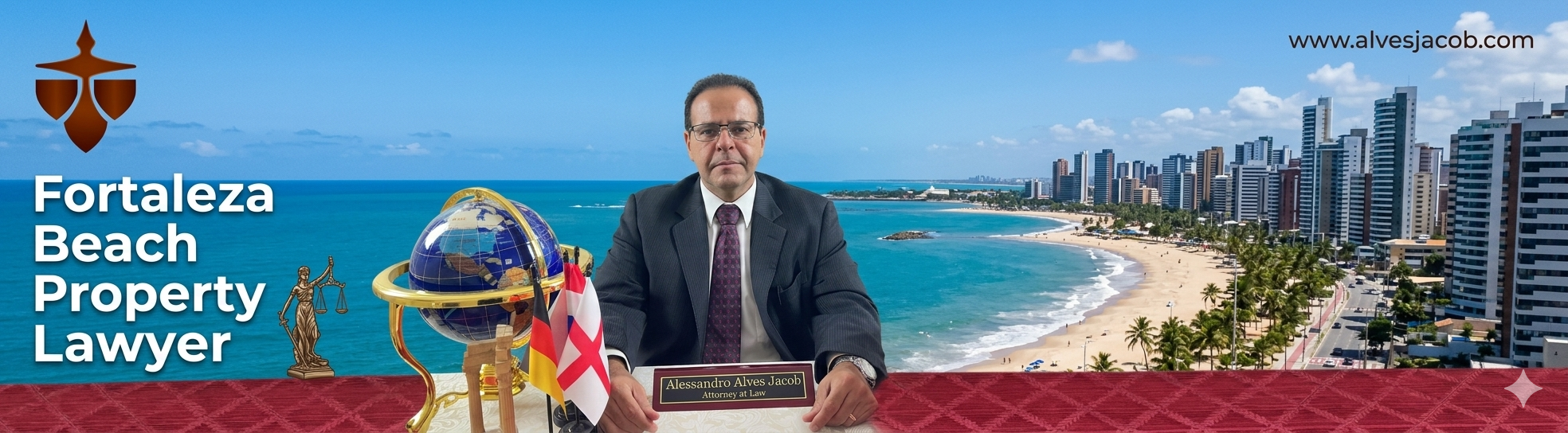
The coastline of Fortaleza and the surrounding beaches of Ceará represent one of the most sought-after real estate destinations in South America. International investors, expatriates, and multinational families are drawn to this region by its year-round climate, expanding tourism infrastructure, and beachfront values that remain remarkably attractive when compared to coastal markets in Europe and North America. Yet beneath the appeal of a beachfront acquisition lies one of the most legally layered segments of Brazilian real estate. Coastal property in Fortaleza is governed simultaneously by federal rules on marine land, environmental protection regimes, municipal zoning, notarial formalities, and registration requirements that differ fundamentally from the systems foreign buyers know at home. A dedicated beach property lawyer in Fortaleza is not a convenience in this market; it is the decisive factor that separates a secure, fully registered beachfront asset from a transaction exposed to title defects, federal encumbrances, and irreversible financial loss.
Beachfront real estate in Fortaleza attracts buyers from across the globe, including investors from the United States, Canada, the United Kingdom, Germany, Switzerland, Scandinavia, Italy, Portugal, and the Middle East. These buyers arrive with expectations shaped by their own legal systems, where title insurance, escrow companies, and broker-driven closings are standard. Brazil operates differently. Ownership is transferred only through registration of a public deed at the competent Real Estate Registry, and the protection of the buyer depends almost entirely on the quality of the legal investigation performed before signing. There is no title insurance industry to absorb mistakes, and there is no second chance once funds have been released against a defective title.
For this reason, sophisticated international buyers retain independent legal counsel before signing any reservation agreement, paying any deposit, or committing to any developer. A beach property lawyer in Fortaleza acts exclusively in the interest of the buyer, independent from brokers, developers, and sellers, and conducts the verification work that determines whether the property can be acquired with full legal security. This independence is precisely what foreign investors value most, because in coastal markets driven by tourism enthusiasm, the only professional with a duty to protect the buyer is the buyer's own attorney, a role explained in depth on our page dedicated to the work of a Brazil property lawyer.
The beaches of Fortaleza, from Praia de Iracema and Meireles to Praia do Futuro, and the broader coastal corridor that includes Cumbuco, Aquiraz, Porto das Dunas, Flecheiras, and the route toward Jericoacoara, fall under a combination of overlapping legal regimes. The beach itself is a public good belonging to the Union and can never be privately owned. Behind the beach lies a federal strip historically classified as marine land, subject to a special regime administered by the federal government. Beyond that strip, private ownership becomes possible, but it remains conditioned by environmental protection rules covering dunes, mangroves, and permanent preservation areas, as well as by municipal master plans that define building heights, density, and permitted uses.
Understanding where a specific property sits within this layered structure is the first task of competent counsel. Two properties separated by a few hundred meters may have entirely different legal natures: one may be full private ownership with an unencumbered registry record, while the other may be federal land held under occupation rights, with annual charges owed to the Union and a federal share due on every transfer. Foreign buyers are rarely told this distinction by sellers or brokers, and discovering it after closing transforms what appeared to be a straightforward purchase into a complex administrative matter. Our firm identifies the exact legal nature of the land before any commitment is made, so that the client negotiates with complete knowledge of what is actually being acquired.
The single most distinctive feature of Brazilian beachfront law is the institute of terrenos de marinha, the federal marine land strip measured from the historic high-tide line. Properties located within this strip are owned by the Union, and private parties hold them under specific legal regimes, most commonly aforamento, which grants the holder useful domain while the Union retains direct domain, or occupation registered with the federal property administration. Each regime carries financial obligations, including an annual charge and, critically for investors, a percentage owed to the Union upon every onerous transfer of the useful domain, known as laudêmio.
For a foreign investor, the practical consequences are significant. The purchase price must be evaluated against the recurring federal charges and the transfer levy. The transaction documents must correctly reflect the transfer of useful domain rather than full ownership. The federal property administration must be consulted to confirm that the holder's record is regular and that no debts encumber the occupation. None of this makes beachfront acquisition inadvisable; thousands of premium properties along the Fortaleza coastline sit on marine land and are bought and sold with complete security every year. What it requires is counsel who handles this regime routinely, verifies the federal records directly, quantifies every charge in advance, and structures the deed so that the buyer's rights are perfected without surprises.
Due diligence is the heart of our work as beach property lawyers in Fortaleza. Brazilian property law concentrates the entire legal history of a property in its matrícula, the individual registry record kept at the Real Estate Registry with jurisdiction over the area. Our investigation begins with a complete certified copy of that record, analyzed across its full chain of title, and extends far beyond it. We examine whether the seller genuinely holds the rights being offered, whether previous transfers were validly executed and registered, and whether the physical property corresponds to the registered description, an issue of particular importance in coastal areas where informal subdivisions and imprecise measurements are common.
The investigation then turns to the seller. We verify civil status and marital property regimes, since the consent of a spouse is frequently indispensable to a valid sale. We obtain certificates covering lawsuits, tax enforcement actions, labor claims, and insolvency proceedings, because under Brazilian law a sale made by a debtor in certain circumstances can be set aside as a fraud against creditors, reaching even a good-faith buyer who failed to investigate. We confirm the absence of condominium debts, municipal property tax arrears, and unpaid federal charges on marine land. Where the seller is a company, the analysis extends to corporate authority and the solvency of the entity itself. This methodology mirrors the comprehensive standards applied throughout our national practice as described by our Brazil real estate lawyer team, adapted to the specific risks of the coastal market of Ceará.
Brazil welcomes foreign ownership of urban real estate, and a non-resident individual may hold beachfront property in Fortaleza in his or her own name with the same substantive rights as a Brazilian owner. The legal prerequisites are objective: the foreign buyer must hold a Brazilian taxpayer registration number, the CPF, which our firm obtains on behalf of clients without the need for travel, and the transaction must comply with the formalities applicable to all property transfers, namely a public deed executed before a notary and subsequent registration at the Real Estate Registry.
What changes for the international buyer is not the right to own, but the practical architecture of the transaction. Documents issued abroad must be apostilled and accompanied by sworn translation. Identity and civil status must be demonstrated in forms acceptable to Brazilian notaries. The purchase funds must enter Brazil through regulated channels, and the buyer's tax position must be organized from the outset so that future rental income or resale proceeds can flow correctly. Our firm has structured these acquisitions for foreign nationals for nearly three decades, coordinating every requirement so that the client experiences a process as orderly as a domestic purchase in his or her own country, with the added protection of counsel who anticipates the points where international elements typically create friction.
The financial leg of a beachfront acquisition deserves the same rigor as the title investigation. Purchase funds remitted from abroad must be converted into Brazilian currency through an authorized financial institution, supported by documentation demonstrating the lawful purpose of the remittance. Properly executed, this process does more than satisfy regulatory requirements; it creates the formal record of the foreign investment that will later support the repatriation of capital when the property is sold, the remittance of rental income, and the demonstration of the original acquisition cost for tax purposes.
Failures at this stage are among the most expensive mistakes foreign buyers make. Funds sent through informal channels, transfers routed through third parties, or remittances unsupported by a coherent contractual trail can block future repatriation and expose the investor to tax and regulatory questioning. Our role is to design the flow of funds before the first transfer occurs, aligning the exchange contracts with the promissory purchase agreement and the final deed, coordinating with the banking institution, and ensuring that every amount entering Brazil is traceable to the transaction. The result is an investment that is not only validly acquired but fully documented as foreign capital, preserving the client's flexibility for every future decision concerning the asset.
A substantial share of the beachfront opportunities offered to international investors in the Fortaleza region involves properties under construction, branded residences, condo-hotel units, and resort developments in areas such as Porto das Dunas, Cumbuco, and the beaches east and west of the capital. These structures are governed by the Brazilian framework for real estate development, which requires the developer to register a complete incorporation record at the Real Estate Registry before selling units. That record discloses the land title, the approved project, the description of future units, and the legal architecture of the development.
Our analysis of an off-plan purchase begins precisely there. We confirm that the incorporation is duly registered, that the developer holds clean title to the land, and that the unit being sold corresponds to the registered project. We examine whether the development is subject to a segregated estate regime that protects buyers' funds from the developer's general creditors, and we scrutinize the purchase agreement for clauses on delivery deadlines, adjustment indexes, penalties, and termination rights. In condo-hotel structures, we additionally review the operating and pool agreements that will govern the investor's income, since the economic promise of these products depends entirely on contractual terms that most buyers never read with legal eyes. This protective review of contractual instruments connects directly with our broader work on lease and income structures described by our Brazil rental agreement lawyer practice.
The natural beauty that gives beachfront property in Ceará its value is protected by an environmental regime that every investor must respect. Dunes, mangroves, riverbanks meeting the sea, and other sensitive formations are classified as permanent preservation areas where construction is prohibited or severely restricted. Municipal coastal management instruments and the master plan of Fortaleza and neighboring municipalities impose additional limits on height, setbacks, and density, particularly in the strips closest to the shoreline. A property may hold perfect title and still be unbuildable, or buildable only within parameters far narrower than the buyer imagined.
Our due diligence therefore includes the environmental and urbanistic dimension of the asset. We verify whether existing structures were built with proper permits, whether any environmental infraction proceedings or judicial actions affect the property, and what the applicable zoning actually permits for the client's intentions, whether those involve renovation, new construction, or commercial exploitation. For raw land along the coast, this analysis is decisive: the difference between a parcel inside and outside a protected formation is the difference between a development opportunity and a permanent restriction. Clients who intend to build receive from us a clear legal picture of what is possible before they commit capital, not after.
Closing a beachfront purchase in Fortaleza involves a defined set of official costs that we quantify for clients in advance. The municipal transfer tax is due on the conveyance and must be paid before the deed can be registered. Notarial fees apply to the execution of the public deed, and registration fees apply to the entry of the transfer at the Real Estate Registry. Where the property sits on federal marine land, the federal transfer charge must also be settled, and proof of regularity with the federal property administration must be presented. Ongoing ownership brings annual municipal property tax and, where applicable, the annual federal charge on the occupation or aforamento.
Equally important is the sequence of these steps. Under Brazilian law, the signature of a deed does not transfer ownership; only registration does. Between signature and registration, the buyer's position must be protected, and the handling of the purchase price must be synchronized with the perfection of title. Our firm manages this sequence end to end, drafting or reviewing the promissory agreement, preparing the deed with the notary, calculating and verifying payment of every tax and charge, and following the registration through to the issuance of the updated registry record in the client's name. The transaction is complete only when the client holds documentary proof of registered ownership, and that is the standard to which we work on every file, consistent with the institutional approach of our real estate law department.
Most of our international clients complete their beachfront acquisitions without setting foot in Brazil until the keys are in hand. Brazilian law fully recognizes acquisition through an attorney-in-fact acting under a power of attorney, and our firm conducts remote closings for clients across every time zone. The instrument is prepared with powers precisely limited to the specific transaction, executed before a notary in the client's country of residence or at a Brazilian consulate, apostilled where required, translated by sworn translator, and registered in Brazil so that it is fully effective before notaries and registries.
Throughout the process, the client remains in complete control. Every document is reported and explained before execution, funds move only against verified conditions, and the client receives the certified registry record evidencing ownership at the conclusion. This capacity for fully remote, fully documented acquisition is one of the principal reasons foreign investors choose our firm: distance ceases to be a risk factor and becomes merely a logistical detail. The same structure serves clients who later wish to sell, lease, or refinance their beachfront property without traveling, preserving the liquidity of the investment regardless of where life takes its owner.
A beachfront property in Fortaleza is rarely a static asset. Many clients monetize their units through long-term leases or short-term vacation rentals, activities that demand properly drafted agreements, attention to condominium rules that may restrict short-stay use, and correct treatment of rental income for tax purposes, including the obligations of non-resident owners. Our firm drafts and enforces these agreements, structures the collection of income, and represents owners in any dispute with tenants, operators, or condominiums.
Equally fundamental is succession planning. Real estate located in Brazil is subject to Brazilian succession proceedings regardless of the owner's nationality or residence, and an unplanned estate can leave heirs abroad facing a judicial inventory in a language and system they do not know. We advise clients on ownership structures, marital property considerations, and testamentary instruments that organize the destiny of the asset in advance, dramatically simplifying what their families will face. For investors building broader Brazilian portfolios, this planning integrates with corporate holding structures and with acquisitions in other markets where our firm acts, including the major urban centers covered by our São Paulo real estate lawyer practice.
The coastal market attracts not only legitimate opportunities but also the recurring patterns of loss that our litigation experience has catalogued over decades. Buyers have paid for land sold by persons who never held title, relying on possession documents that confer no ownership. Buyers have acquired units in developments whose incorporation was never registered, leaving them as unsecured creditors of an insolvent developer. Buyers have purchased properties later reached by creditor claims against the seller, by undisclosed heirs, or by environmental demolition orders. Buyers have remitted funds informally and found themselves unable to repatriate their own capital years later.
Every one of these scenarios is preventable, and the cost of prevention is a fraction of the cost of litigation. Independent legal representation transforms the acquisition from an act of trust in strangers into a verified, documented, and registrable transaction. Our firm has also defended and recovered the position of buyers who came to us after problems emerged, litigating before the courts of Ceará and negotiating with developers, sellers, and authorities. That litigation experience informs our preventive work: we know exactly how coastal transactions fail, because we have spent decades repairing the ones that did, supported by our established presence through our attorneys in Fortaleza.
Our firm has represented foreign nationals in Brazilian real estate matters for nearly three decades, combining full fluency in English with deep command of the federal, environmental, notarial, and registry regimes that govern the coast of Ceará. Clients work directly with senior counsel experienced in international coordination, accustomed to apostilles, sworn translations, cross-border funds flows, consular procedures, and the expectations of investors who demand clear communication and decisive execution. We maintain an established presence in Fortaleza and act throughout the coastal municipalities of the state, from the urban beaches of the capital to the developing corridors east and west.
Engaging our firm means the entire acquisition is conducted under one professional responsibility: the legal nature of the land confirmed, the title investigated to its foundations, the seller vetted, the contracts negotiated in the client's interest, the funds structured for compliance and future repatriation, the deed executed, every tax settled, and ownership registered and delivered in documentary form. For investors who intend to hold, rent, build, or eventually sell, the relationship continues with the same standard of care. If you are considering beachfront property in Fortaleza or anywhere along the coast of Ceará, we invite you to contact us before you sign anything, because the most valuable legal work in this market is the work done before commitment, not after.
Can a foreigner buy beach property in Fortaleza, Brazil?
Yes. Foreign individuals and companies may own urban beachfront real estate in Fortaleza with the same substantive rights as Brazilian owners. The buyer needs a Brazilian taxpayer number, properly legalized documents, and a transaction executed by public deed and registered at the Real Estate Registry.
Do I need to live in Brazil or have a visa to own property in Ceará?
No. Property ownership in Brazil does not require residence or any visa. Non-residents own beachfront property throughout the Fortaleza region, and the entire acquisition can be completed remotely through a power of attorney.
What are terrenos de marinha and how do they affect my beachfront purchase?
Terrenos de marinha form a federal strip along the coast owned by the Union. Properties within it are held under useful domain or occupation regimes, with annual federal charges and a percentage due on each transfer. They can be bought securely, but the federal records must be verified and the charges quantified before closing.
Is it safe to buy property directly on the beach in Brazil?
It is safe when the legal nature of the land, the title chain, the seller's situation, and the environmental status are professionally verified before any payment. The risks in coastal transactions are real but entirely identifiable through proper due diligence conducted by independent counsel.
How long does it take to buy a beach house in Fortaleza?
A well-organized transaction typically moves from accepted offer to registered ownership within several weeks to a few months, depending on the speed of certificate issuance, the regularity of the seller's documents, and whether federal marine land procedures apply.
What taxes do I pay when buying beachfront property in Ceará?
The buyer pays the municipal transfer tax, notarial fees for the public deed, and registration fees at the Real Estate Registry. Properties on federal marine land also involve the federal transfer charge. Ongoing ownership carries annual municipal property tax and, where applicable, the annual federal charge.
Can I buy land near the beach and build a house on it?
Often yes, but coastal land is subject to environmental preservation areas and municipal building parameters that vary street by street. The buildability of a specific parcel must be legally confirmed before purchase, which is a core component of our due diligence for raw land.
What is a matrícula and why does it matter for my purchase?
The matrícula is the individual registry record of the property at the Real Estate Registry, containing its description, ownership history, and encumbrances. Ownership in Brazil exists only as registered in this record, which is why its complete analysis is the foundation of every secure acquisition.
Do I need a CPF to buy property in Brazil and how do I get one?
Yes, every buyer needs a CPF, the Brazilian taxpayer registration number. Our firm obtains the CPF for foreign clients through documentary procedures that do not require travel to Brazil, usually within a short period at the start of the engagement.
Can I complete the entire purchase from abroad without traveling to Brazil?
Yes. Through a properly drafted power of attorney, apostilled and translated, our firm executes the deed, pays the taxes, and registers the property on your behalf. You receive certified proof of registered ownership without leaving your country.
How do I safely transfer money to Brazil to pay for the property?
Purchase funds must enter Brazil through an authorized financial institution under a documented exchange operation tied to the transaction. Structured correctly, this creates the formal record that later permits repatriation of capital and remittance of rental income.
What happens if the seller has debts or lawsuits I do not know about?
Sales by indebted sellers can in certain circumstances be challenged by creditors, reaching even the buyer. This is precisely why our due diligence includes judicial, tax, and labor certificates on the seller, so that these risks are identified and resolved before any payment.
Is buying an off-plan beach apartment from a developer in Fortaleza safe?
It can be, provided the development has a duly registered incorporation, the developer holds clean title, and the contract protects the buyer on delivery, adjustment, and termination. We verify all of these elements before our clients sign or pay anything.
Can I rent out my beach property to tourists when I am not using it?
Generally yes, subject to condominium rules that may regulate short-stay rentals and to the correct tax treatment of rental income earned by non-resident owners. We draft the agreements and organize the income structure so the activity is fully regular.
What happens to my Brazilian beach property when I die?
Real estate located in Brazil passes through Brazilian succession proceedings regardless of the owner's nationality. Advance planning through appropriate ownership structures and testamentary instruments dramatically simplifies the process for heirs living abroad, and we advise on this as part of our service.
Why should I hire my own lawyer instead of relying on the broker or the developer's staff?
Brokers and developers represent the sale, not the buyer. Only independent counsel has the professional duty to investigate the title, vet the seller, and negotiate the contract in your exclusive interest. In a system without title insurance, that independence is your real protection.
Do you communicate in English throughout the entire process?
Yes. Our practice is built around international clients, and all communication, reporting, and explanation of documents is conducted in clear English, with sworn translations arranged whenever foreign documents must be used in Brazil.
Can your firm represent me if a problem has already occurred with a property I bought?
Yes. Beyond preventive work, we litigate and negotiate on behalf of buyers facing title defects, developer defaults, possession disputes, and registration problems before the courts of Ceará, drawing on decades of contentious experience in Brazilian real estate.
How do your legal fees work for a beach property purchase?
We provide a clear written proposal before the engagement begins, defining the scope of the work and the corresponding fee, so that you know precisely what is included from due diligence through registered ownership, with no ambiguity at any stage.
How do I start working with your firm on a beachfront acquisition in Fortaleza?
Simply contact us by email with a description of the property or opportunity you are considering. Senior counsel will assess the matter, identify the immediate legal questions, and present a structured proposal for conducting your acquisition with full legal security.
https://www.alvesjacob.com/brazil-property-lawyer.html
https://www.alvesjacob.com/brazil-real-estate-lawyer.html
https://www.alvesjacob.com/sao-paulo-real-estate-lawyer.html
https://www.alvesjacob.com/real-estate-law.html
https://www.alvesjacob.com/brazil-rental-agreement-lawyer.html
https://www.alvesjacob.com/fortaleza-attorneys.html
Send email to: info@alvesjacob.com
 Mr. Alessandro Jacob speaking about Brazilian Law on "International Bar Association" conference
 Av. Presidente Wilson, 231 / Salão 902 Parte - Centro
CEP 20030-021 - Rio de Janeiro - RJ
+55 21 3942-1026
Travessa Dona Paula, 13 - Higienópolis
CEP -01239-050 - São Paulo - SP
+ 55 11 3280-2197